Conexões do discurso de Hitler à TOK

Hitler é, de todos os políticos que já estudei ou prestei atenção, dos mais geniais. A maneira como escrevia os seus discursos e o seu poder de oratória davam-lhe uma vantagem tremenda comparada a outros políticos da altura e mesmo aos de agora. O trunfo de Hitler para conquistar o coração do povo Alemão, antes de se revelarem as suas verdadeiras intenções ou se revelar quem realmente era este homem, foi a vergonha do povo Alemão ao perder a Primeira Guerra Mundial. Esta é a maior conexão dos discursos de Hitler à disciplina de Theory of Knowledge.

Hitler usou a duas maneiras de saber incluíndo a memória e a emoção do público para conseguir manipulá-los e convencer-lhes de que a melhor aposta para a reconquista da sua honra era ele. Com a memória da humilhação da derrota ainda bastante fresca o público-alvo de Hitler, nesta altura ainda pessoas bastante adultas, ou maiores de idade com uma relação forte as gerações anteriores, seguiu cegamente Hitler que aparentava ser um homem sem medos e com ideias claras, transparentes e do agrado daqueles que o seguiam. O conhecimento dos fatores mais influentes das ciências humanas, uma área de conhecimento em TOK, ajudou Hitler a ser bem sucedido naquilo que eram as suas intenções. Conseguiu manipular uma nação, com um povo com capacidades intelectuais bem presentes, quase no seu todo.

Paper 1- Crónica de Ricardo Araújo Pereira

A crónica de Ricardo Araújo Pereira intitulada “Não mandas em mim, iPhone” fala da experiência do autor com o seu smart phone. A crónica retrata acontecimentos do seu quotidiano que quase todos os leitores conseguem simpatizar. O uso destes eventos verídicos tornam a leitura mais apelativa e o sentimento de empatia mantem o leitor interessado. O autor usa uma linguagem simples e alguns recursos estilísticos para comunicar a sua mensagem.

Depois de ter escrito este paper achei que consegui tocar em todos os pontos fundamentais mas vim a descobrir que existem algumas coisas que posso fazer para melhorar ainda mais a minha nota. Baseado nos comentários recebidos para melhorar a minha análise de paper 1 tenho que melhorar a minha caligrafia porque dificulta a leitura e condiciona o entendimento daquilo que escrevi afetando negativamente a nota. Devo trabalhar também no estabelecimento de relações entre o publico-alvo e a mensagem do texto. Falei muito vagamente deste tema e não cheguei ao fundo da questão, revelando pensamento crítico. Para melhorar este aspeto tenho que acrescentar este ponto logo no meu plano para não me esquecer ao escrever o análise. Devo, por último, fazer uma análise mais profunda no seu todo explicando as implicações das escolhas estilísticas do autor e o impacto que isto tem no publico e no sucesso da passagem da mensagem.

Group IO Preparation

We began preparing IO topics in small groups that consisted of people who analysed the same article by Moira Donegan in their Paper 1. This group preparation has really helped to clarify a few different aspects and forced me to think deeper into the issue instead of being somewhat superficial. As we are there is a lot of thinking going on and a lot more things are being unpacked from the two texts being studied, that I perhaps wouldn’t have gotten if I was on my own.

We decided to focus on the global issue of women perpetuating their own oppression for self-preservation. What exactly does this mean? We are looking at how, in both texts, women make decisions that are not beneficial to other women but that are still made because they will benefit them as an individual. This is clear in THT as Serena Joy known that her freedom will be reduced but that it won’t completely disappear as she is a Wife. However, she does not believe in what she preaches and her actions cause the great oppression of the Handmaids. In Moira Donegan’s article she condemns women who still vote for Trump, white women more specifically. These women are part of the “privileged” group and therefore will feel only the reduced effects of the vote they cast compared to women who belong to “minority” groups. This is a perfect representation of women perpetuating their own oppression for self-preservation.

We unpacked what these two texts have to offer in terms of this “provocation”, looking closely at the authorial choices. The text type of these two works is a very important part of the analysis as they are different and therefore reach two different audiences, regardless of having the same intention. The way they tell the story also sheds a negative light on these women, especially because of their target audience, who agrees with their liberal opinions.

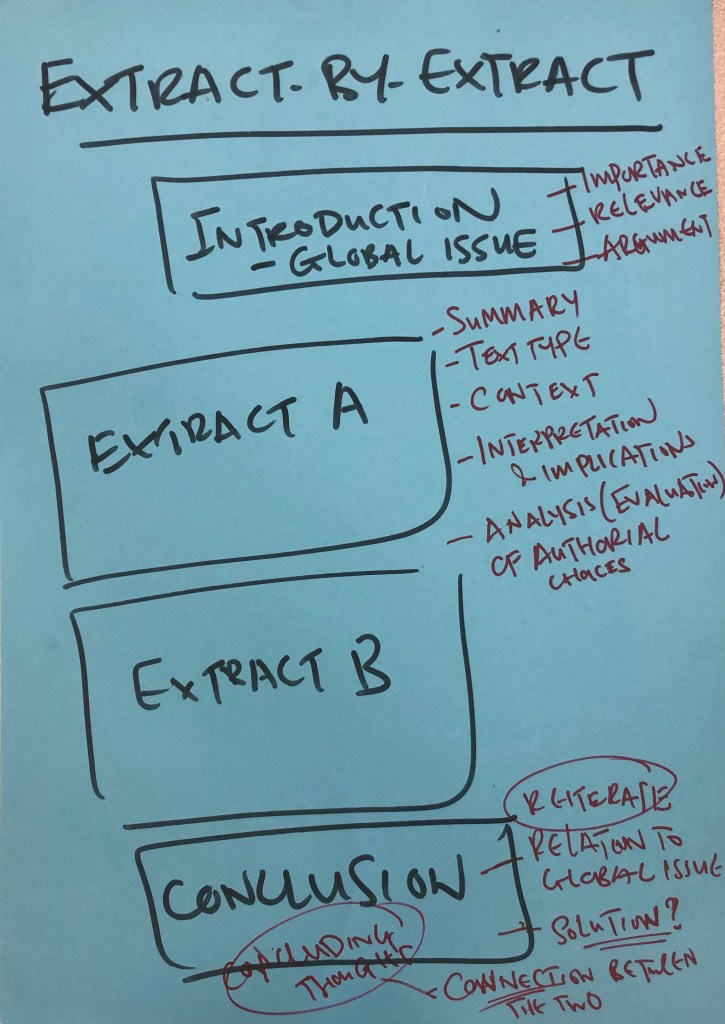
IO Extract-by-extract Structure

On the contrary of the comparative structure the extract-by-extract structure is much simpler and easier to do. It resembles an essay in terms of what should be where and what each part consists of. The introduction is simple and only require three things, the importance of the issue, the relevance and the argument being made within the field of inquiry or SDG. The topic within each extract are the same and touch base on everything that can be unpacked from the texts. This goes from a brief summary, to the type of text, to a deeper analysis of the authorial choices and their importance and impact on the audience. The conclusion offer a solution, when possible, a connection between the two texts and a reiteration of the main points of the body of the presentation.

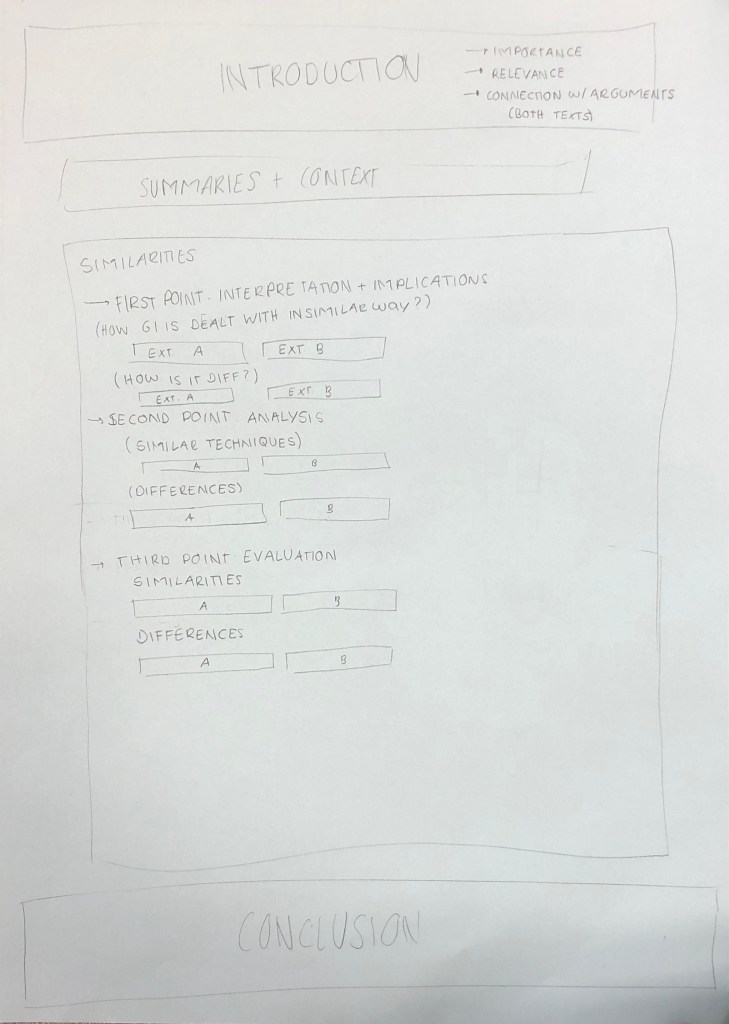
IO Comparative Structure

There are two main IO structures, one of them being comparative. The comparative structure is where similarities and differences are at the epicentre of the analysis and are supported by relevant points from each extract. There are specific details that need to be included in the introduction and there has to be a clear connection between the two extracts and the argument being made. There are three main body paragraphs that speak about different aspects on the texts; the first speaking about the interpretation and implications of the text, the second is the analysis of techniques, and third is the evaluation. A comparative IO is the most challenging of the two structures but it is the structure that can be explore the most and analysed in greater depth.

Practice IO Preparation

The global issues present in The Handmaids Tale and the articles written by Moira Donegan are very similar. They both portray the disadvantages of being a woman within society, though one is non-fiction and the other is fiction, the systematic and institutionalised oppression of women and the subconscious acceptance or blind eye towards male superiority and dominance.

Coming up with a global are that related to both texts was fairly easy as I had a good understanding of both. Our multiple reads of The Handmaids Tale really helped me to understand the small details in the novel and the “hidden” messages behind what Atwood wrote. The straightforward and intuitive writting by Donegan made it very simple to comprehend what she was trying to portray, or protest against. As I began to think about the issues present in both these texts I realised that politics, power and justice was the biggest, most present one, within the two bodies of text. In the article by Moira Donegan, recounting the testimony by Christine Blasey Ford during Brett Kavanaugh’s trial, it is evident that there is still a fundamental problem with the US justice system: male superiority and impunity. The fact Ford was a woman meant she had to conceal her emotions and pretend to be something or feel things she wasn’t necessarily feeling at the moment because she knew that her anger could be “punished, ridiculed or taken as a sign of lack of credibility”. That really made me think. Why is it that women have to change their way in order to get something? How do we think that rights for women have in fact changed when things like this still happen today with people believed to be “privileged” due to race?

This same global area is present in THT as men hold far higher power in regards to women. Women are shamelessly objectified and stripped of their rights as humans. They have only one purpose in life and that is to procreate. With men being the providers, decision-makers and leaders of the household and country women are left with nothing or little to live for. Although this is a much deeper and fantastical reality than that of Donegan’s articles it is similar in the sense that women’s rights are still limited and that despite the common thought of there finally being equality we are still far from that.

This led me to think of the following global issue: the widespread acceptance of male superiority and oppression of women. Of course this is isn’t true for many people but it is still a reality in many different places. Some continue to believe that women are inferior to men and that they are of less value. This is, directly or indirectly portrayed in both texts and is a possible IO topic I could focus on.

IO Links Between Column Articles and THT

Moira Donegan and Margaret Atwood are both very critical women. They have well established views and make their voices heard through they’re chosen form of writing. In The Handmaid’s Tale Atwood makes various issues very clear to the reader. Same goes for Donegan. Most of the issues raised in both of these works are related to one global issue: politics, power and justice. However, some issues that are raised, particularly in The Handmaid’s Tale, relate closer to the global issue of beliefs, values and education.

When it comes to politics, power and justice there is a clear sense of inequality within both texts. Donegans articles show the gap between men and women mostly within the justice system, while Atwood shows the severe oppression of women in a society with antiquated beliefs that strongly favour men in every domain of life. Although there are difference in the way these issues are portrayed and the way in which the stories are told the underlaying fact is the same; women are seen as inferior to men even where they should hold equal rights, such as the judiciary system.

Both women also reiterate the global issue of beliefs, values and education, for different but similar reasons. Atwood shows this through the Aunts who have the function of educating and passing down knowledge through the Handmaids. The beliefs and ideas being passed down to the Handmaids are somewhat outdated and very different from the ones they previously had coming from a “modern” society. This shows the influence people in power, the Aunts, have over the rest of society. The ideals the aunts present to the Handmaids relates somewhat closely to the ideals of members of the Republican party. As the man in power has such archaic beliefs and moral, people below him are influenced as they are “loyal” to their leader. Hence, some women still vote Republican even with all the disadvantages that come with it.

Column Articles

As is expected by the IB curriculum English Language students are required to study literary and non-literary works. We looked at political cartoon first and now began studying column articles. We looked particularly into a female columnist, Moira Donegan. Moira is an American columnist for The Guardian. She is a very established feminist and stands up for women’s rights regardless of race, sexual orientation or beliefs. Her outspoken personality shows that she does not conform to societal norms. She does not believe in the fact the women should behave in a predefined way and that men hold any sort of superiority to women.

These views are clear in the way that she writes. Her articles usually relate to the mistreatment of women within society- American society. She also questions herself about some women’s choices and why they still make decisions that some would consider outdated even after there has been so much evolution in the mentality of society.

“What Christina Blasey Ford reveals about womanhood” is my favourite article so far by Moira Donegan. In this article she speaks about Ford’s testimony during Brett Kavanaugh’s trial, a man she accused of sexually assaulting her. This article reveals many different aspects that need to be corrected. Moira’s way of writing is unconsciously convincing and her tone intentionally, though subtly, angers the reader. One of the main issues raised by the article is the inequality of women before justice. This is seen in the description of Ford’s posture and obvious fear when in front of the judges. The comparison between the 1991 case of Anita Hill also raises a point. That point being the fact that change hasn’t really happened for women yet, in fact, they might’ve regressed. Black women have for centuries been at a disadvantage to white women and therefore Hill’s case was no surprise at the time. However, Ford, a white woman with a PhD was more of a shock to society. It leaves the reader thinking where we are now and what progress there has really been regarding women’s rights. In my opinion- very little. We are very stuck on the superficial things when there are real issues for women in the deepest layers of society that are often forgotten.

Prática para Paper 2- Preocupações sociais presentes na Crónica

A novela “Crónica de uma Morte Anunciada” de Gabriel García Marquez retrata a história de um casamento falhado que levou a morte de um homem, supostamente inocente, numa tentativa de reconquistar a honra da família. O autor faz críticas fortes e bem focalizadas a sociedade da altura de forma subtil mas bem perceptível. Marquez, foca em um aspeto fundamental- os papel da mulher na sociedade- que abrange e toca em vários outros aspetos das tradições e culturas da altura em questão.

O papel da mulher na sociedade Colombiana da altura era similar ao de outras partes do mundo, visto que a história acontece no início de século XX. A mulher desta sociedade é confinada a trabalhos domésticos e as suas opiniões e sentimentos são tratadas com desprezo. A mãe de Ángela Vicário é a representação da mulher da sociedade e durante uma caracterização feita pelo narrador sobre a família Vicário, o leitor apercebesse de como as coisas realmente eram para as mulheres. Quando o narrador de diz que “Puríssima de Carmen, a mãe, tinha sido professora primária antes de casar para sempre” (p. 31) o narrador está implicitamente a insinuar que apesar de se ter casado, de sua vontade ou não, Puríssima não tem mais nenhuma alternativa a não ser continuar no casamento para o resto da vida. Sendo assim, é claro de que as mulheres não tinham a escolha, nem o direito ou hipótese, de se divorciarem dos maridos. Para além disso, as mulheres eram “criadas para casar” (p. 32). A expectativa era que as mulheres fossem boas donas de casa que soubessem arrumar e limpar e serem, acima de tudo, submissas e dependentes dos maridos assim que saíssem da casa dos pais porque, na realidade, “foram criadas para sofrer” (p. 32) como dizia sua própria mãe. As filhas de Carmen “sabiam bordar com bastidor, coser à maquina, fazer renda de bilros, lavar e engomar, fazer flores artificiais e doces de fantasia, e redigir participações” (p. 32). Todas estas habilidades foram ensinadas expressamente as meninas da família deixando de parte os rapazes. Os homens foram simplesmente “criados para para serem homens” (p. 32), neste contexto, era esperado que arranjassem uma mulher, tivessem filhos e que fossem os encarregados do sustento da família após o casamento. Além de serem educadas someone com o propósito de serem boa donas de casa, as mulheres da altura era viviam com uma constante pressão social no que toca aquilo que delas é esperado.

Na altura em que decorre a história existia a expectativa de que as mulheres sejam virgens, e deste modo, preservando a sua inocência para depois de consagrado o matrimónio. O grande dilema da novela começou na primeira noite depois do casamento de Ángela Vicário e Bayardo San Román porque Ángela já não era virgem no dia do seu casamento. Este facto abriu o caminho para o termino do casamento entre os dois e a devolução de Ángela aos seus familiares por Bayardo que a “empurrou suavemente… para dentro de casa, sem dizer palavra” (p. 45). A perda da virgindade de Angela antes do casamento causou a perda de honra que se inseriu na família após o descobrimento dos factos. A “legítima defesa da honra” (p. 47), levou os gémeos Vicário a assassinar Santiago Nasar, condenado por Angela como o homem que se envolveu com ela. Apesar de haver tantos problemas a volta da virgindade de Ángela não há qualquer preocupação em termos da virgindade de Bayardo San Román. Isto torna a mensagem de desigualdade social, onde as mulheres estão em desvantagem, ainda mais clara. Não há discussão possível no que toca a inferioridade da mulher nesta sociedade.

Apesar de contar uma história interessante, Marquez faz também uma crítica social bem profunda sobre os papéis sociais de cada sexo na altura tornando a leitura ainda mais cativante e apelativa a emoção do leitor, visto que leva-os a pensar e refletir naquilo que acabaram de ler, visto que, feliz ou infelizmente, existem muitas semelhanças entre a sociedade da altura da história e da sociedade atual.
Contexto histórico e cultural na leitura

A interpretação de um texto depende muito do conhecimento que o leitor tem anteriormente. É muito importante o leitor estar situado geograficamente, assim como cultural e historicamente, quando lê qualquer tipo de texto porque entenderá o porquê das coisas estarem a acontecer, da maneira que acontecem. Os costumes, tradições e maneiras de ser e estar variam mediante a cultura das pessoas e isso reflete-se no texto de alguma forma. Sendo assim, é de extrema importância o leitor estar consciente destes três aspectos contextuais. Por exemplo, na leitura de Crónica de uma morte anunciada, o tempo em que a estória acontece é muito importante porque ajuda o leitor a ter uma ideia do papel social de cada sexo, sem achar que o autor se refere a uma sociedade altamente atrasada dos dias de hoje. O leitor consegue também, devido a contextualização, entender o porquê de certas coisas, como o drama a volta de Santiago Nasar e Angela Vicário, que se deve a falta de “inocência”, ou ao facto de Angela Vicário já não ser virgem no dia do seu casamento. Em dias correntes, tal coisa já não seria um problema, pelo menos em maior parte do mundo, mas na altura em que foi escrito o livro, ou em que a estória é contada, isto é realmente um grande problema. O leitor passa a entender os papeis sociais pelas pistas que o autor vai dando durante a obra e dessa maneira, em adição ao tempo, o leitor vai percebendo cada vez mais sobre a cultura em referência, que, apesar do mesmo período temporal, pode variar bastante comparativamente a outras partes do mundo.

Design a site like this with WordPress.com
Get started