Abortion debate connection to The Handmaid’s Tale

One of the biggest topics that aroused from our debate on abortions when both sides expressed their opinions was male dominance and control over women. This was brought up when speaking about abortions because of legislations and the justice system, which are two major government organs that ultimately make decisions over people lives, rights and freedoms. With that being said, it is safe to say that having so many men in positions of power limits the voice women have within the decision making of the laws that are passed. Male dominance links directly to the novel as women have no more importance than any other object laying around; their sole purpose was to reproduce and increase the decreasing population of pre-Gilead days. Gilead in itself became a Republic because of the beliefs men had and the lack of importance they felt with the uprise of feminism and movements that empowered women and no longer worshiped men during the previous republic. Revolted by their lack of importance in society, the men began a revolution to bring back everything that they felt they had lost and regain the manhood. However, this didn’t only cut down the freedoms of women but also those of men as they were also assigned specific rules and laws to abide by.

Another topic that was widely spoken about when we had the debate on abortions was rape. Many times women who choose to have an abortion are led to this decision because they have been raped. In the Handmaid’s Tale the reader immediately understands that although the Handmaids are engaging in sexual activity with the Commanders it is not necessarily out of free will but rather out of fear and oppression. In a case where a Handmaid denied having sex with a Commander she would be sent to the colonies where the “unwomen”, or women who are infertile, go to, only horrible stories are known about this place, which invokes further fear into the women. In Gilead, the republic the Handmaids live in, rape is institutionalised and people are forced to accept it the way it is because of lack of choice. However, in our current society, as discussed during the debate, rapists who commit horrible crimes get a small prison sentence compared to those of a doctor who performs an abortion surgery. This is when we ask ourselves how moral our society is and how much longer we are willing to accept that only a handful of people, who inaccurately represent our society as a whole, make every decision including those that negatively affect peoples lives, reduce the rights of minorities and fail to acknowledge that everyone is different and that not everyone will conform to the social norms and stigmas established over centuries of religious and political oppression and brainwashing.
Internal Oral connections to Debate on Abortions

We were asked to, in groups, prepare a debate speech that either opposed or enforced a certain idea, regardless of our own personal opinions. Two topics were discussed: is abortion morally wrong? and do fetuses have rights? Because we didn’t get to choose which side we were on and what we defended these debates brought up very interesting points that maybe a lot of people hadn’t thought about because we limited ourself to only know about what we believed in and were ignorant towards the other side of things. This isn’t to say that we changed our opinions on the matter based on the debates but there were a few eye-openers and there were definitely some connections made between the debate and the global issues that could be discussed in the Internal Oral (IO). On interesting topic that was brought up was rape. In many cases women choose to have an abortion because they are victims of rape and the long-term consequences of having a “rape-child” outweigh the “immorality” of getting the procedure done. This then lead to a conversation about male dominance, specifically in legislations and justice systems. Most legislations, the government organ that is responsible for passing laws, are male dominated in many, if not most, countries, this poses a problem as it is ultimately up to the men in power to make decisions for women who are the ones that are directly involved in the situation. We discussed how these laws that limit the freedom of women and impose regulations on what they can and can’t do with their bodies are only passed because legislations are male dominated. Not only are legislations male dominated but the justice system, who enforce the rules passed by legislations, are also male dominated. This is when the rules and regulations passed are used and abused to strip women even more of their freedom and their rights as humans. In short, men have control over women’s lives and choices through laws, policies and regulations that put limits to the freedom of these individuals.

The Handmaid’s Tale- Individual Oral Preparation

From the group discussions we had in our small literary circles many different topics were mentioned and discussed as we tried to make sense of the novel and the different events that were taking part as the plot went along. We came to realise from these conversations that the reality experienced by the people of Gilead is not as distant from where we are now as it might seem. In fact, many places have very similar realities to the one in The Handmaid’s Tale. The story is told from the perspective of a woman who sees her world get turned upside down from what corresponds to our reality nowadays to something only imaginable in nightmares. The American government gets murder and overruled, women are robbed of their right to own property and private ownership, and are forced to rely solely on men as the providers. In this story women are the most oppressed and impacted gender as they are reduced to objects and serve the single purpose of carrying powerful men’s children and reproducing in order to maintain the human species alive.

As mentioned previously the reality experienced in Gilead is not very distant from the one we are living in now. For example, in chapter 28 women’s accounts and assets were frozen and passed to their husbands or sons this was a measure taken by the new government to limit the independence of women and make sure that men have the final say over what they can and cannot do. This decision was also made to make sure that women are not able to escape the country and purchase goods they thought were inappropriate. In many cultures and religions, just like Margaret Atwood’s novel, the role of decision-making belongs to the man and women are confined to domestic chores and reproduction as well as a pleasure object for the husband. In the novel we are frequently exposed to the objectification and degrading of women, which is not at all far from what we currently have in our world. We often see advertisements that depict women as being weak, fragile, powerless beings that are meant solely for sexual pleasure and reproduction. Of course, unlike in Gilead, this message isn’t conveyed directly at us but it can it present we if look at the smaller details such as the clothes the women wear, the position they are in, the facial expressions that many times resembles one of sadness and emptiness, as well as the contrast between the position of the man in regards to the woman in the advertisement.

Another big issue faced by the people of Gilead that corresponds to our current world is the problem of immigration. In the novel we are presented to this topic when Offred, the protagonist, tries to escape along with her family looking for a better option and is denied that right, leading her to try and escape illegally getting caught in the process. This incredibly similar to the problems we have now concerning immigration. Many countries impose very strict restrictions on the immigration process that makes this option harder than it should be, which forces people to remain in the uncomfortable and unhealthy circumstances they are currently facing in the country they’re currently living in. They aren’t able to seek asylum in countries with higher standards of living or escape conflict in order to protect their lives and those of their children. The author not only speaks about immigration but also about the weakness of different, and somewhat outdated, government systems, this being dictatorships. The author makes use of wrongful imprisonment, capital punishment and the death penalty to show the injustices of dictatorships.

With this novel, the author tries to push readers to act on the issues she mentioned, by showing what the world could possibly look like if we don’t do so immediately.

Literary Circle- Clarification of reading from chapter 26-40

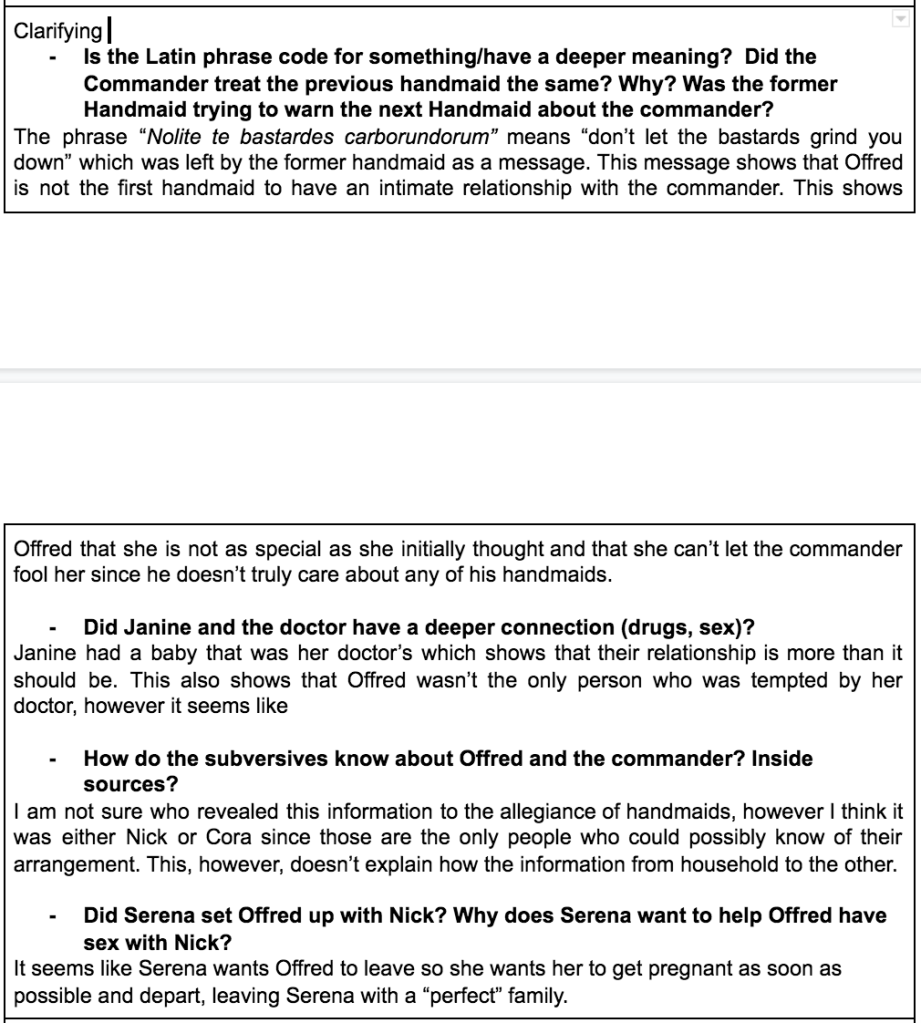
Screenshot of clarifying notes from literary circle discussion

The section we read that spans from chapter 26 to chapter 40 was one of the most information and event packed ones yet. We learnt much more about the characters and there was a quick change in from one event to another. We get a deeper look into the relationship between the Commander and Offred as they develop their friendship into an affair that begins to raise suspicions. From the phrase engraved in her room, Offred learns that she is not the only one that has had this kind of relationship with the Commander which makes her realise that he does not truly care about any of his Handmaids and that she should be careful not to let herself be fooled like some of the previous ones. In short, this phrase serves as a warning to future Handmaids. We also learn that Ofwarren (Janine) has a child with the doctor, which means that they have a relationship that goes beyond simply patient-doctor. Soon it is discovered that the child belongs to the doctor and it is considered an unbaby. This scene between Janine and the doctor shows us, the readers, that it is not an uncommon occurrence that doctors try to have sexual relationships with the Handmaids as it happened to Offred as well. The subversives know about the affair between the Commander and Offred which means someone must have told them. We assume that it must have been either Cora or Nick as they are the only two people who possibly know about it.

Serena and Offred have had a bitter relationship since Offred arrived and this is still visible in the later chapters of the novel. In this section of the book, both women acknowledge the fact that there is a possibility the Commander could be sterile and therefore Serena arranges an encounter between Offred and Nick, in an attempt to get her pregnant and force her to leave the Fred household sooner rather than later. This is a strategy that she has come up with to get rid of Offred.

O desconcerto na lírica de Camões

O desconcerto é a incompatibilidade entra a experiência e a teoria, que tenciona harmonizar a razão e o desejo. Neste ideal irrealista o amor serve como forma de entendimento. O desconcerto é, na realidade, a aceitação compulsiva da desordem da vida e à irracionalidade das pessoas.

O desconcerto é representado na lírica camoniana através do amor, da amada e do amante. O sujeito poético muitas vezes debate como o amor pode ser caminho para o Bem, beleza pura e juntamente o furor que impulsiona as piores culpas. Assim como os aspectos malignos e traiçoeiros das mulheres mesmo sem perder a sua beleza.

Apesar de tudo isto o sujeito poético rejeita-se a continuar na incompreensão e continua à procura do que deveria ser incessantemente.

A representação da amada na poesia de Camões

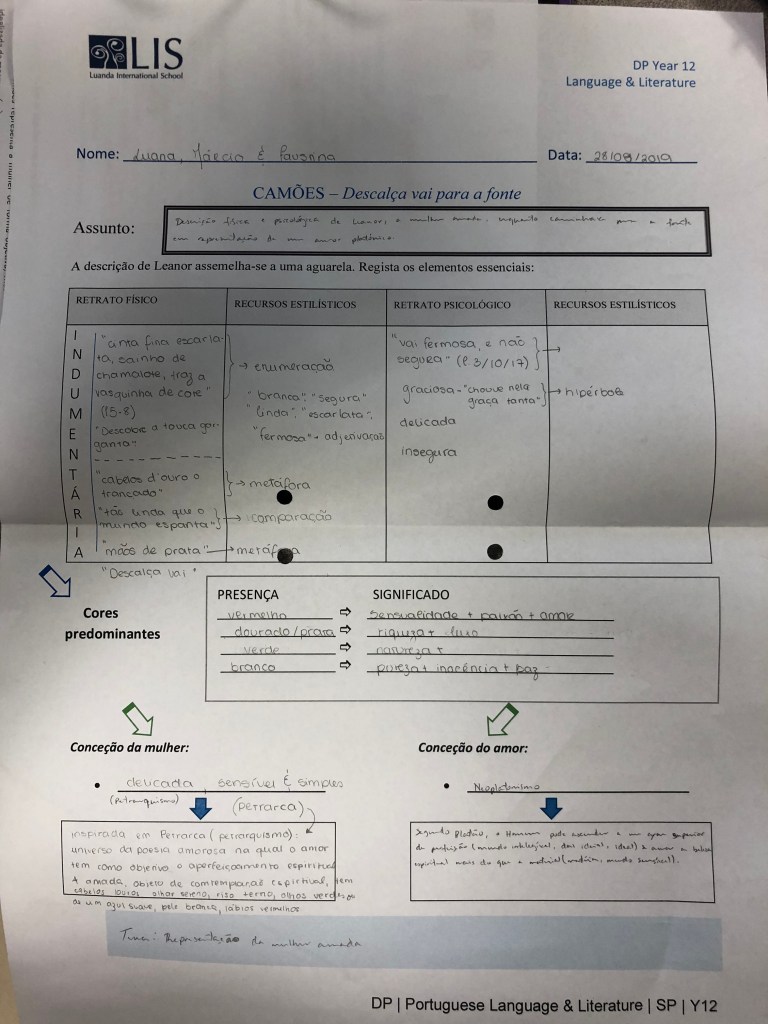
A representação da amada de Camões é inspirada por Petrarca e a sua conceção da mulher. O ideal petrarquista é uma mulher de cabelos loiros e pele branca. É também uma mulher muito serena, impalpável, inacessível e símbolo de harmonia e perfeição.

Nos vários poemas de Camões estudados, é claro um padrão preestabelecido da amada. Por exemplo, no primeiro poema analisado “Descalça vai para a fonte”, é claro através da descrição física e psicológica de Leanor que esta é de facto uma mulher petrarquista. No 5º verso temos uma caracterização física de Leanor em que o sujeito poético diz que ela tem “mãos de prata”. Esta frase revela que a amada tem um tom de pele muito branco e que as suas mãos são delicadas. Mais abaixo, no 9º verso o poeta descreve Leanor como sendo “mais branca que a neve pura”. O leitor é novamente relembrado desta qualidade específica da amada. No 12º verso o leitor é confirmado que Leanor é realmente uma mulher petrarquista visto que tinha “cabelos d’ouro”. Uma das características da mulher petrarquista.

“Descalça vai para a fonte” é um dos poemas de Camões escritos na medida velha. Em contraste, o soneto “Um mover d’olhos brando e piadoso” é também um poema de Camões mas que segue a estrutura da medida nova. Tendo isto em conta, o leitor poderá achar que a conceção da amada mudará igualmente. Julgando pela caracterização física e psicológica da protagonista é possível deduzir que esta, tal como todas as outras, é uma mulher petrarquista. Por exemplo, 10º verso Camões descreve a amada como tendo um “ar sereno”. Como foi mencionado anteriormente, uma das características da mulher petrarquista é a serenidade. Na última estrofe quando o sujeito poético fala sobre o efeito da amada em sua vida, ele descreve-a como sendo a “minha Circe”. Circe era uma deusa grega conhecida como sendo a mulher mais bela que tinha o poder de atrair qualquer homem que desejasse. Esta é mais uma característica petrarquista desta protagonista.

Em conclusão, Camões é fiel a conceção da mulher petrarquista e as suas características, nomeadamente os cabelos loiros, a pele branca, serenidade, o amor platónico e a harmonia e perfeição.

Camões- A experiência amorosa e a reflexão sobre o amor

No poema “Amor é um fogo que arde sem se ver”, o leitor é apresentado a um novo tópico no que se trata de poemas de Camões. Os últimos três textos analisados têm sido apenas caracterizações idealizadas de uma amada, no caso de Camões, a mulher petrarquista. Em contra partida, este poema Camões dedica-se a descrever e a refletir na experiência amorosa, tanto dele como de outras pessoas também.

Com o uso de uma anáfora o poeta dá a entender que tenta ao seu melhor descrever o que é o amor mas mesmo depois das 11 tentativas, o leitor vem a perceber que mesmo assim ele não consegue entender como algo tão contraditório como o amor acontece a tanta gente. Nas suas 11 tentativas, nas primeiras três estrofes, Camões usa antíteses para reforçar o sentimento contraditório que é o amor. Na ultima estrofe, o poeta começa com “mas” para questionar tudo aquilo que mencionou anteriormente. O poema começa e acaba com a palavra “Amor”, feito deliberadamente para dar a entender ao leitor que o real motivo do poema é descrever e/ou tentar definir o amor.

“The Handmaid’s Tale”- Context and Research

Today we did some research into the background of the novel “The Handmaid’s Tale” by Margaret Atwood. By researching about the events taking place during this time period, mostly focused on the 1980s with some previous to that, we were able to give ourselves some context, which will help us to better understand the novel when we start reading it because we will easily be able to make connections to the events we looked into.

During this time period many events were taking place such as the development of In Vitro Fertilisation (IVF), which is a process that the egg and the sperm are combined outside the body, meaning people who have trouble having children naturally can have this procedure done instead. This is especially important to note because there was also an infertility scare blamed on women due to their “liberalised sexual activities”. One thing I found out as well was that the name of the book was loosely inspired by the New Jersey Handmaidens. During one of her research trips Atwood found a fundamentalist Christian group: The People of Hope. This group believed that the world should go back to its “roots”, based on the rules and teaching of the bible. The women that belonged to this group were called “the Handmaidens of God”. From that she found the name for her dystopia’s subservient female characters, and the inspiration for the fictional religious group who would take over the government.

We then took a look at a quote from an unpublished essay by Atwood called “The Handmaid’s Tale – Before and After”. The quote we looked says the following: “It’s set in the near future, in a United States which is in the hands of a power-hungry elite who have used their own brand of ‘Bible-based’ religion as an excuse for the suppression of the majority of the population. It’s about what happens at the intersection of several trends, all of which are with us today: the right of right-wing fundamentalism as a political force, the decline of the Caucasian birth rate in North America and northern Europe, the rise of in infertility and birth-defect rates, due, some say, to increased chemical pollutant and radiation levels, as well as to sexually transmitted diseases“. After the research we did we can conclude that Atwood has deliberately and directly made references to the reality lived during the time the novel was written to, in a way, make a prediction about what would happen to the world in the future.

Political Cartoons

Over the past week we have been looking at political cartoons by different cartoon artists. These cartoons are similar in the fact that they all protest against sexual assault and violence towards women. Many of the cartoons we looked at involved US President Donald Trump, unfortunately not to reference him as an advocate of this global issue but as one more well connected individual who gets away with such crimes due to his political and societal status. With a history of sexual abuse, harassment and misconduct, Trump was targeted by many cartoonists when it came to his fitness of serving as president. One cartoon by Nick Anderson shows a caricatured portrayal of Trump about to have a Tic Tac looking at three women pictured and labelled as [statue of] Liberty, [Lady] Justice and Truth. The Tic Tacs are a reference to the leaked audio of a conversation between Trump and Billy Bush in 2005, when they were recording a video for Access Hollywood with Arianne Zucker, where Trump states “I better use some Tic Tacs just in case I start kissing her (Referring to Zucker). You know I’m automatically attracted to beautiful. I just start kissing them. It’s like a magnet. Just kiss. I don’t even wait”. Going back to the cartoon and the importance of the Tic Tac reference, it makes it clear to the reader the main message trying to be communicated: Trump, once president, will abuse his power over the three women exposed in the cartoon; Liberty, Justice and Truth, getting himself, along with other members of his administration and inner, away safe with what would be unacceptable in any other circumstance or involving any other people. 

Design a site like this with WordPress.com
Get started